Dark warehouse – will future warehouses operate without humans?
Logistics and intralogistics have been undergoing a rapid transformation in recent years. A growing number of orders, increasingly shorter delivery times, and pressure to reduce costs mean that traditional operational models are no longer sufficient. Companies are required to execute processes faster, more predictably, and while maintaining high efficiency at the same time.
One of the biggest challenges remains the shortage of warehouse workers and internal transport operators. In many industries, it is becoming increasingly difficult to scale operations solely by increasing headcount. At the same time, the development of robotics, artificial intelligence, and advanced software is taking warehouse automation to a completely new level.
In response to these challenges, the concept of the dark warehouse is emerging more and more often — a warehouse capable of operating with minimal human involvement and in darkness. Just a few years ago, this was considered a futuristic vision; today, it is becoming a real direction in modern intralogistics development.
In this article, we will look at what a dark warehouse is, which technologies enable its operation, and why autonomous warehouses are becoming one of the most important logistics trends of 2026. Enjoy the read.
What is a dark warehouse?
A dark warehouse is a concept of a logistics facility in which most processes are carried out automatically, with minimal human involvement. The name comes from the idea of operating “without lights,” as fully automated facilities theoretically do not require the constant presence of people or continuous lighting.
In practice, however, a dark warehouse does not mean the complete elimination of human workers. Specialists are still needed to supervise systems, perform maintenance, plan operations, and manage logistics processes. What changes is the nature of their work — from manual execution of tasks to managing and coordinating an automated environment.
A dark warehouse is not a single technology, but rather a whole ecosystem of interconnected systems operating in real time.
How does an autonomous warehouse work?
In a modern warehouse, most logistics processes can be carried out automatically — from goods receipt all the way to truck loading.
The process typically starts with inbound deliveries and product identification using scanning systems and automated data exchange. The goods are then transported to the appropriate zones by AMR mobile robots or conveyor systems.
Storage is often handled by AS/RS systems, which automatically place items in designated locations and retrieve them when an order is being fulfilled. Order picking can be supported by cobots or pick & place robots that take over repetitive operations.
The next stages include palletizing, load securing, and shipment preparation. Increasingly, even trailer loading processes are being automated, which helps reduce downtime and increase warehouse throughput.
What is most important, however, is that all these elements are fully synchronized. An autonomous warehouse operates like a single organism in which data, robots, and control systems continuously exchange information and respond to changing operational conditions.
What technologies enable the operation of a dark warehouse?
AMR robots – autonomous internal transport
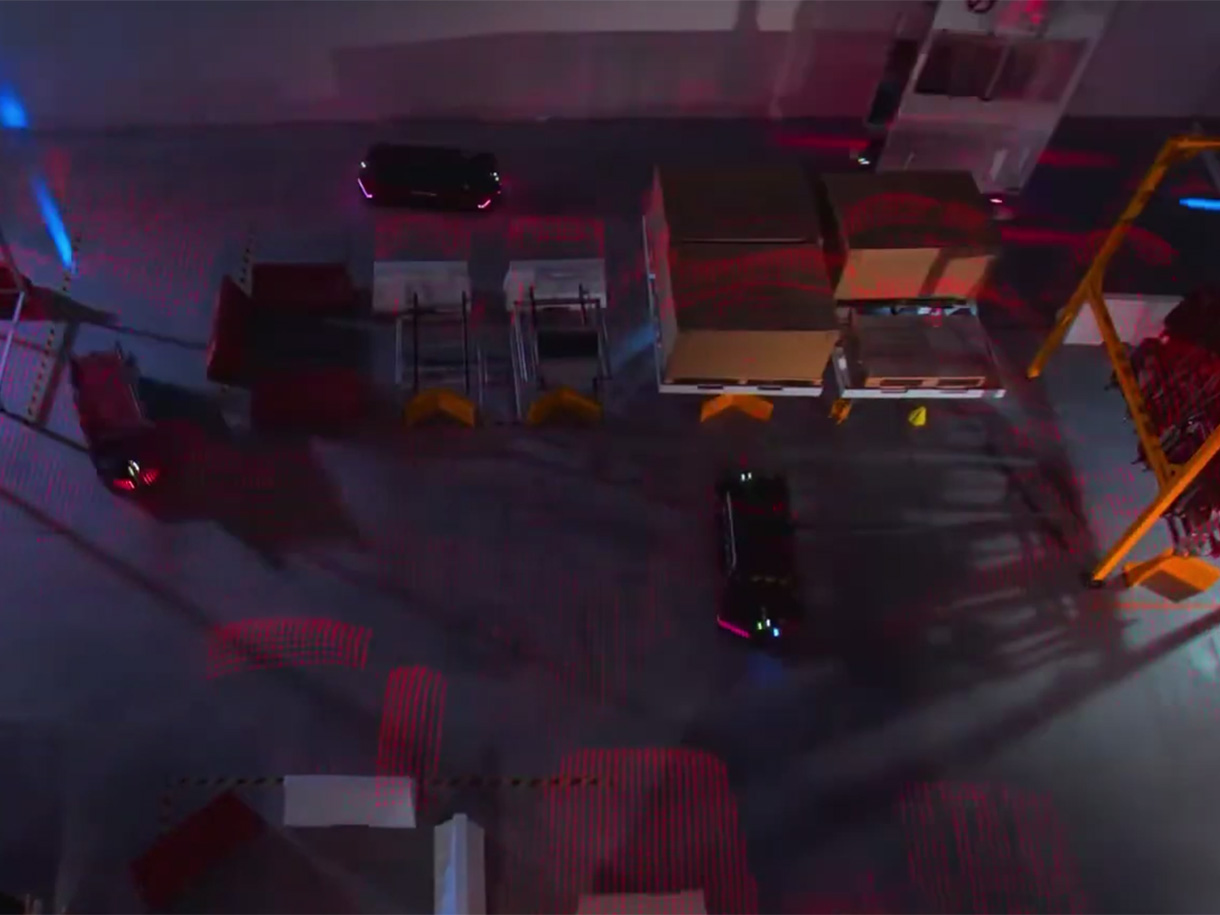
One of the foundations of a dark warehouse are autonomous mobile robots (AMRs) like Versabot 500 or Versabot 1500. They are responsible for transporting pallets, containers, or components between different warehouse zones.
Unlike traditional forklifts, AMRs do not require an operator and are able to independently plan routes, avoid obstacles, and dynamically respond to changes in their environment. This makes it possible to reduce empty runs and use warehouse space more efficiently.
An additional advantage is scalability — a robot fleet can be relatively easily expanded as operational volumes grow.
AS/RS systems – automated storage and retrieval
AS/RS (Automated Storage and Retrieval Systems) are automated solutions used for storing and retrieving goods in a warehouse without human involvement. They typically consist of high-bay racking systems, stacker cranes, and conveyors integrated with a WMS system that manages product flow.
Their use improves warehouse space utilization, reduces worker movement, and speeds up logistics operations. In a dark warehouse, AS/RS often forms a key part of the infrastructure, ensuring a smooth and largely autonomous flow of goods.
Cobots and industrial robots
Cobots (collaborative robots) and industrial robots are key elements of automation in a dark warehouse, taking over tasks related to the physical handling of goods. They most often take the form of multi-axis robotic arms mounted on workstations or integrated with conveyor systems. They are equipped with grippers (e.g. vacuum, mechanical, or adaptive), vision systems, and force sensors, which allow them to accurately identify, pick up, and place a wide variety of products.
Industrial robots typically operate in dedicated, fully automated zones and perform highly repetitive tasks such as palletizing, depalletizing, or sorting. Cobots, on the other hand, can work closer to humans and flexibly support processes such as order picking, packing, and pick & place operations, easily adapting to changing product assortments. As a result, they automate the most time-consuming and monotonous tasks, increasing the efficiency, precision, and stability of warehouse operations as a whole.
Automation of loading and unloading
One of the most demanding stages of warehouse logistics remains truck loading and unloading. This is often where delays occur and bottlenecks form.
This process is increasingly supported by automated loading systems, which reduce vehicle handling time and improve synchronization with internal transport. Solutions such as Q-Loader ATLS enable the automatic loading of pallets into trailers, reducing the need for manual operations and increasing throughput in shipping areas.
In a dark warehouse environment, loading automation becomes a natural extension of the autonomous flow of goods.
Conveyor systems and warehouse racking
In modern warehouses, conveyor systems and properly designed racking structures also play a key role. They ensure a continuous flow of goods and enable efficient use of available space.
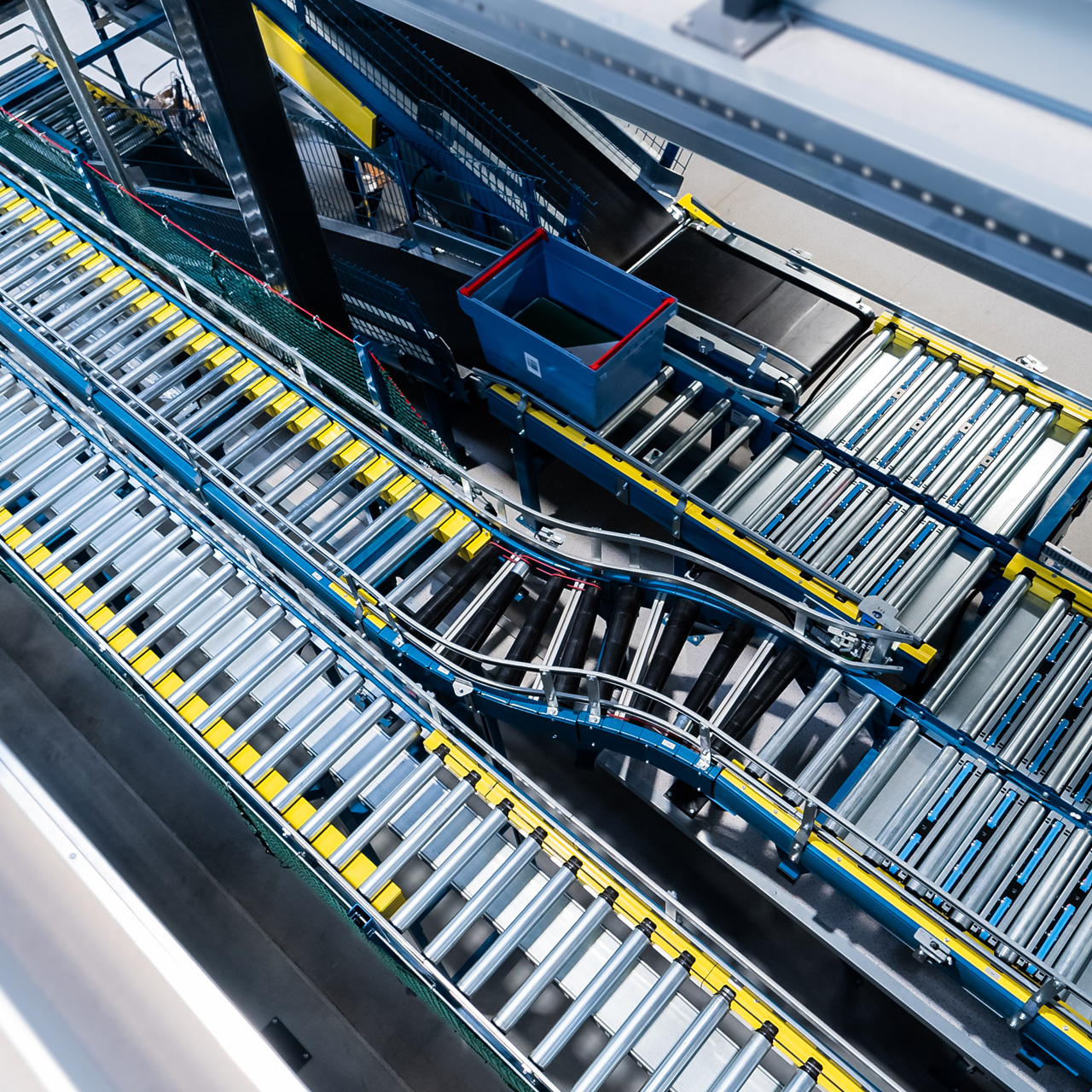
Conveyor systems allow for the automated transport of products between different warehouse zones — from receiving, through picking and palletizing, all the way to shipping. This reduces the number of manual operations and shortens the time needed to move goods within the facility. In a dark warehouse environment, conveyors often integrate the work of various automation components and robots into a single, cohesive material flow system.
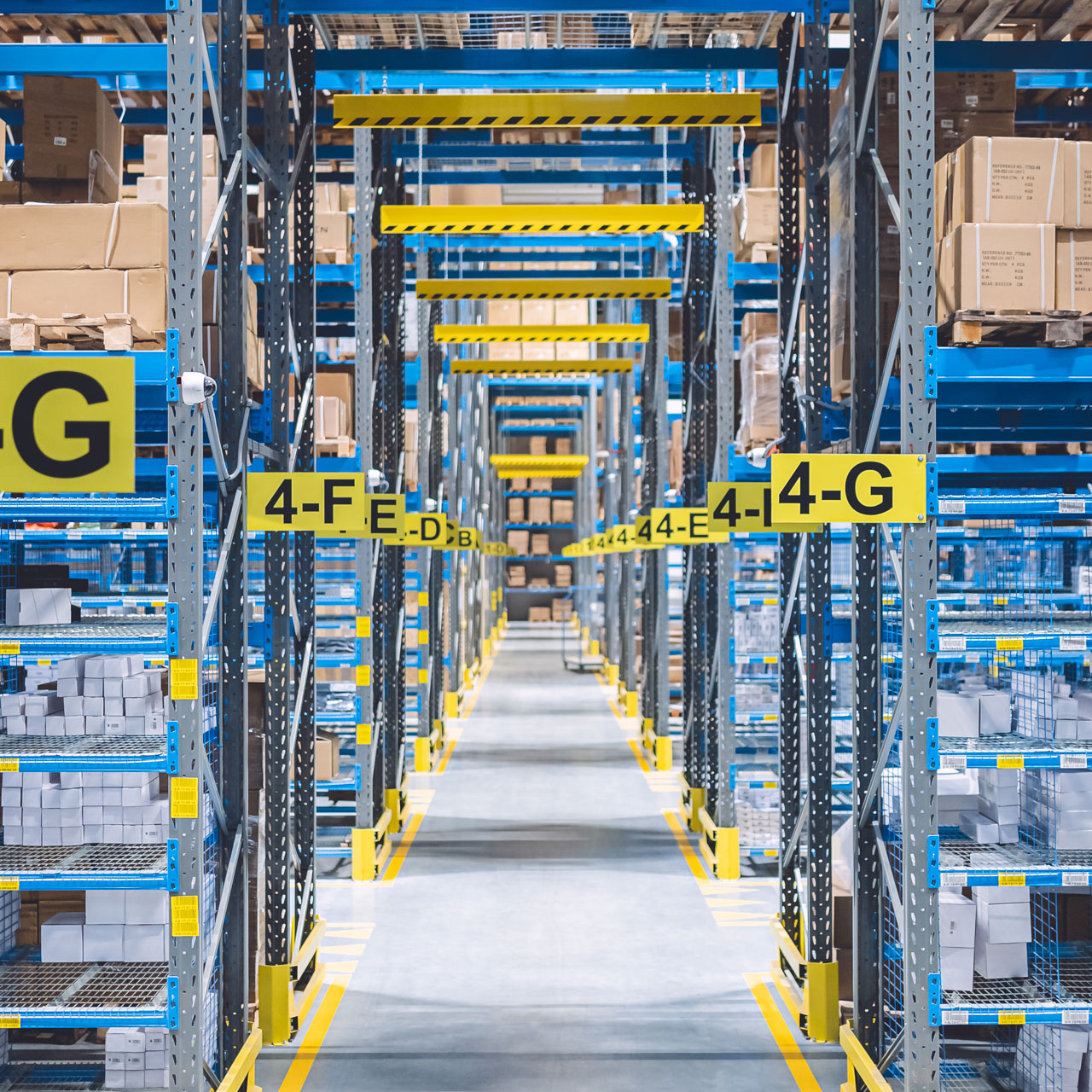
Equally important are warehouse racks themselves and the overall spatial layout. In autonomous warehouses, the layout is designed to maximize space utilization, shorten transport routes, and reduce unnecessary movement. Proper rack placement increases throughput and better aligns the environment with the operation of AMR robots and other automation systems.
AI and software – the brain of the autonomous warehouse
However, the key element of a dark warehouse is not the robots themselves, but the software that manages the entire environment.
It is software systems and AI algorithms that are responsible for:
- planning robot movements,
- synchronizing processes,
- prioritizing tasks,
- monitoring material flows,
- analyzing operational data,
- predicting workloads and potential delays.
Without proper orchestration, even the most advanced automation can lead to bottlenecks and inefficiencies. That is why integration platforms that connect all elements of the warehouse environment into a single system are becoming increasingly important, such as Autonomy@Work.
Why is dark warehouse becoming important in 2026?
The growing importance of dark warehouses is a direct result of the pressure faced by modern logistics. Companies today operate in an environment of labour shortages, rising labour costs, and increasingly high customer expectations regarding fast order fulfillment. In particular, the rapid growth of e-commerce means that warehouses must handle larger volumes of orders in shorter time frames and with lower tolerance for errors.
An additional challenge is the need for continuous operation — 24/7 — as well as the ability to manage highly variable and difficult-to-predict demand. In such conditions, traditional warehousing models become less flexible and harder to scale. In contrast, the automation typical of dark warehouses allows for stable performance regardless of workload and increases the operational resilience of the entire supply chain.
Benefits of implementing a dark warehouse
Operational benefits
Implementing a dark warehouse primarily improves day-to-day warehouse operations. Automation increases process efficiency, shortens order fulfillment times, and reduces the number of errors caused by human factors. Thanks to the use of automated systems, it is also possible to maintain high throughput and continuous operation around the clock, without interruptions related to shift scheduling or workforce availability.
Business benefits
From a business perspective, a dark warehouse increases operational scalability and makes it easier to adapt to changing demand. Companies gain more predictable operating costs and become less dependent on labour availability in the job market. As a result, their competitiveness improves, as they can respond more quickly to customer needs and handle a growing number of orders more efficiently.
Energy and environmental benefits
Automation in a dark warehouse translates not only into operational efficiency, but also into more effective use of energy and resources. Robot control systems enable route optimization, elimination of empty runs, and reduction of unnecessary operations, which in turn lowers energy consumption across the entire logistics process.
An additional benefit is the ability to reduce costs related to lighting and heating, as highly automated warehouses do not require the constant presence of employees. As a result, the dark warehouse concept aligns with the broader trend of improving energy efficiency and reducing the environmental footprint of logistics.
Read more about the environmental impact of AMR robots here: Are AMRs eco-friendly?
Is a fully human-free warehouse realistic?
Despite the rapid development of technology, fully unmanned warehouses remain rare and are not yet a standard in the industry. In most cases, companies implement automation gradually, combining human work with robotic systems.
The role of humans in such an environment does not disappear, but it changes — instead of performing physical operations, employees increasingly take on supervisory and control functions. This includes monitoring system performance, coordinating processes, maintaining automation systems, and analysing operational data.
A dark warehouse should therefore not be understood as a warehouse without people, but rather as an environment in which technology takes over repetitive and physically demanding tasks.
How do software and simulations help design a dark warehouse?
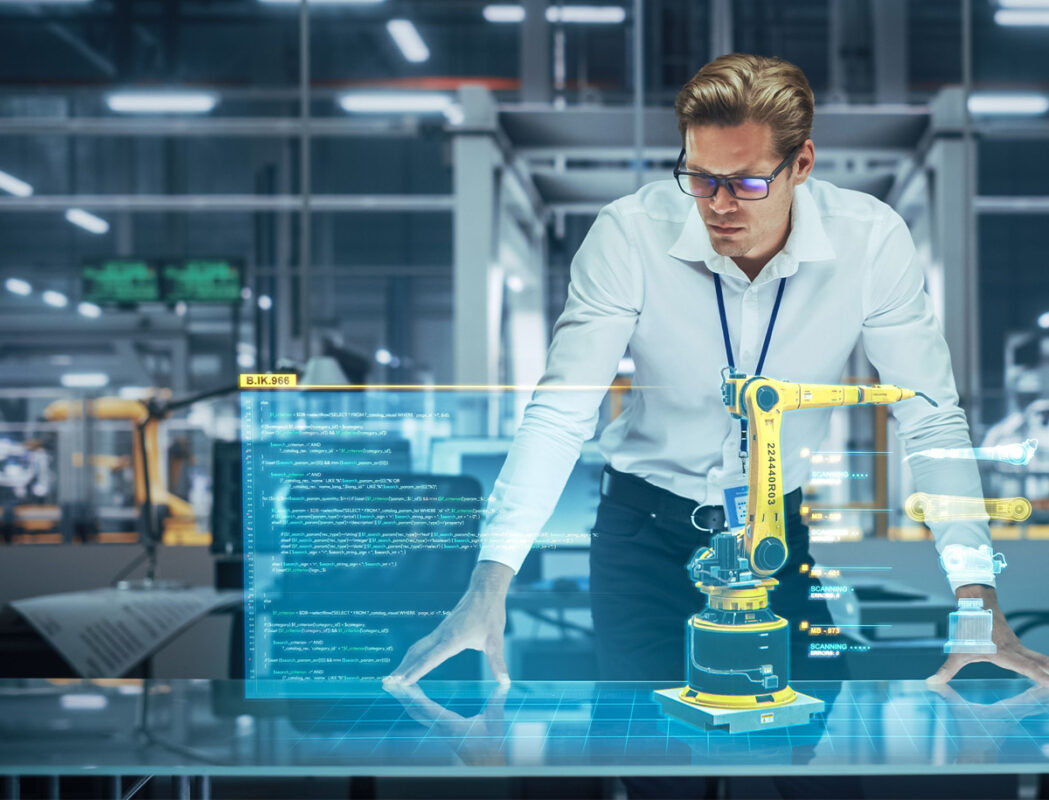
Designing an autonomous warehouse requires careful planning even before any physical infrastructure is implemented. A key role is played by simulation tools and digital models of logistics processes, such as Virtual Factory systems, which allow the behaviour of a warehouse to be replicated in a virtual environment.
Thanks to simulations, it is possible to test different operational scenarios, analyse material flows, identify potential bottlenecks, and optimise the warehouse layout. This also makes it easier to determine the appropriate number of robots and predict system load under varying operating conditions.
This approach significantly reduces investment risk and allows the design to be better aligned with future operational needs before physical implementation begins.
Read more about virtual simulations here: What is a digital factory?
Challenges of implementing a dark warehouse
Despite its many benefits, implementing a dark warehouse also comes with significant challenges. The most important ones include high investment costs and the complexity of integrating different automation systems, software, and warehouse infrastructure.
Data standardisation is also crucial, as is ensuring the security of the entire technological environment, which must operate reliably and consistently. In addition, the transformation process requires gradual adaptation of the organisation and operational processes in order to fully unlock the potential of automation.
A dark warehouse is therefore not just a technology deployment, but a comprehensive transformation of the warehouse operating model, requiring a well-planned strategy and consistent execution.
Conclusion – are dark warehouse solutions the future of logistics?
The dark warehouse concept is one of the most visible directions in the development of modern intralogistics. Increasing automation, the growth of AI, and the need for greater operational resilience are making warehouses increasingly autonomous.
At the same time, the future of logistics will likely not be based on completely eliminating humans, but rather on intelligent collaboration between people, robots, and software. It is this combination of automation, data, and advanced software that enables the creation of warehouse environments capable of operating faster, more efficiently, and more predictably.
For many companies, a dark warehouse is no longer a futuristic vision, but a real development path that can be implemented step by step — adjusting the level of automation to their operational and business needs.